Resources
Exploring the Heart of Storytelling - The Nayaka and Nayika in Bharatanatyam
The concept of Nayaka and Nayika play a pivotal role in Bharatanatyam especially to portray abhinaya (facial expressions) themed dance compositions. This topic has always intrigued me and led me to explore more about it. I have shared what I’ve read from articles about Natya Shastra and texts like Rasamanjari, Dasarupakam and of course this is not exhaustive
Who is Nayaka and Nayika?
The plot or the composition revolves around these two lead characters.They hold social status and qualities that are both innate and acquired. Nayaka is one who begins a situation not in favour of him but as the drama unfolds he wins over. A Nayika is usually portrayed as a passionate and devoted lover who represents various shades of love.
Why do we have a hero or heroine?
The main aim is to achieve the purpose set by the dramatic plot. The hero is expected to be worthy of ‘purushartha’ and the heroine is expected to be worthy of the hero. It can also simply be a dramatic necessity!
TYPES OF NAYAKA
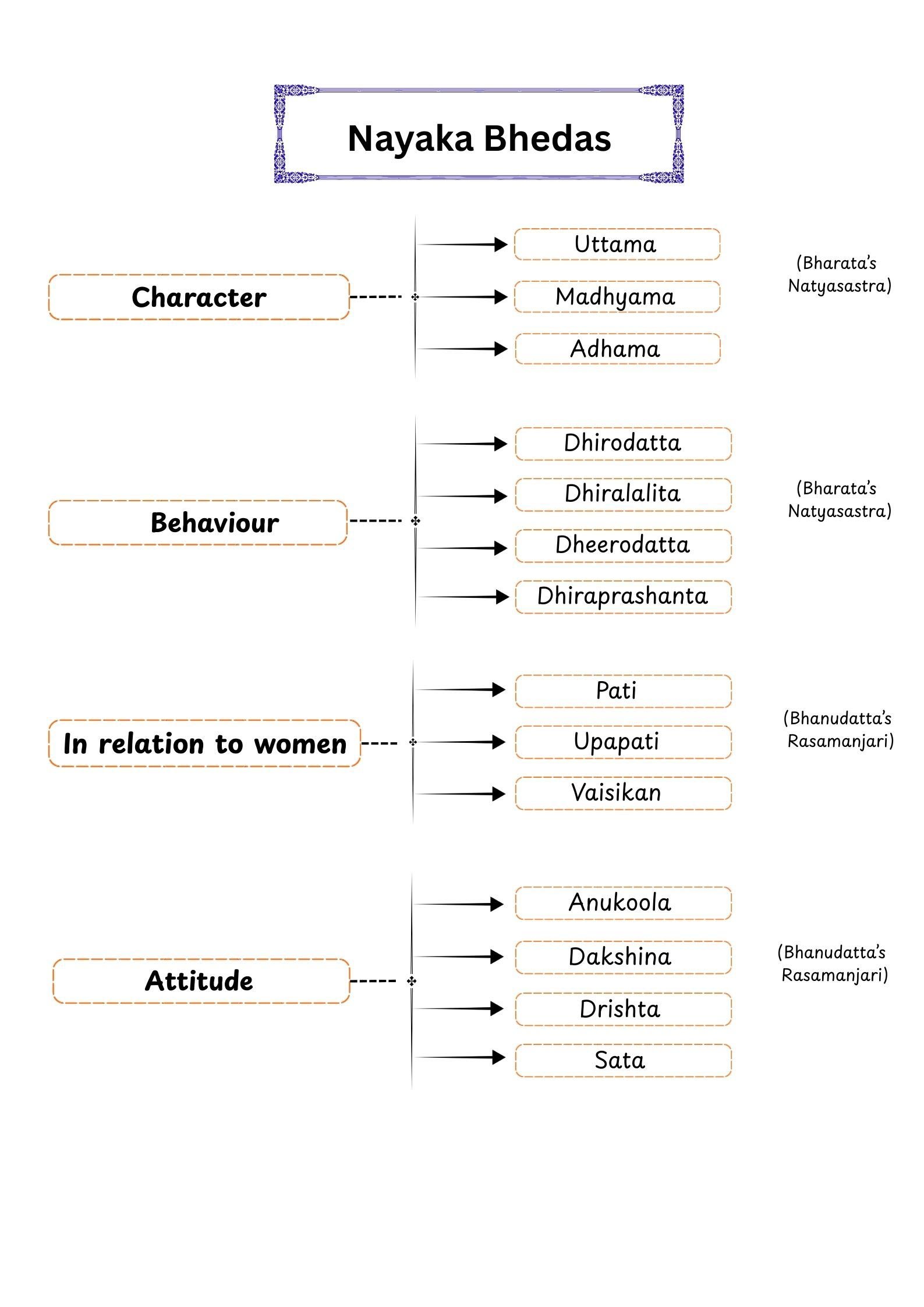
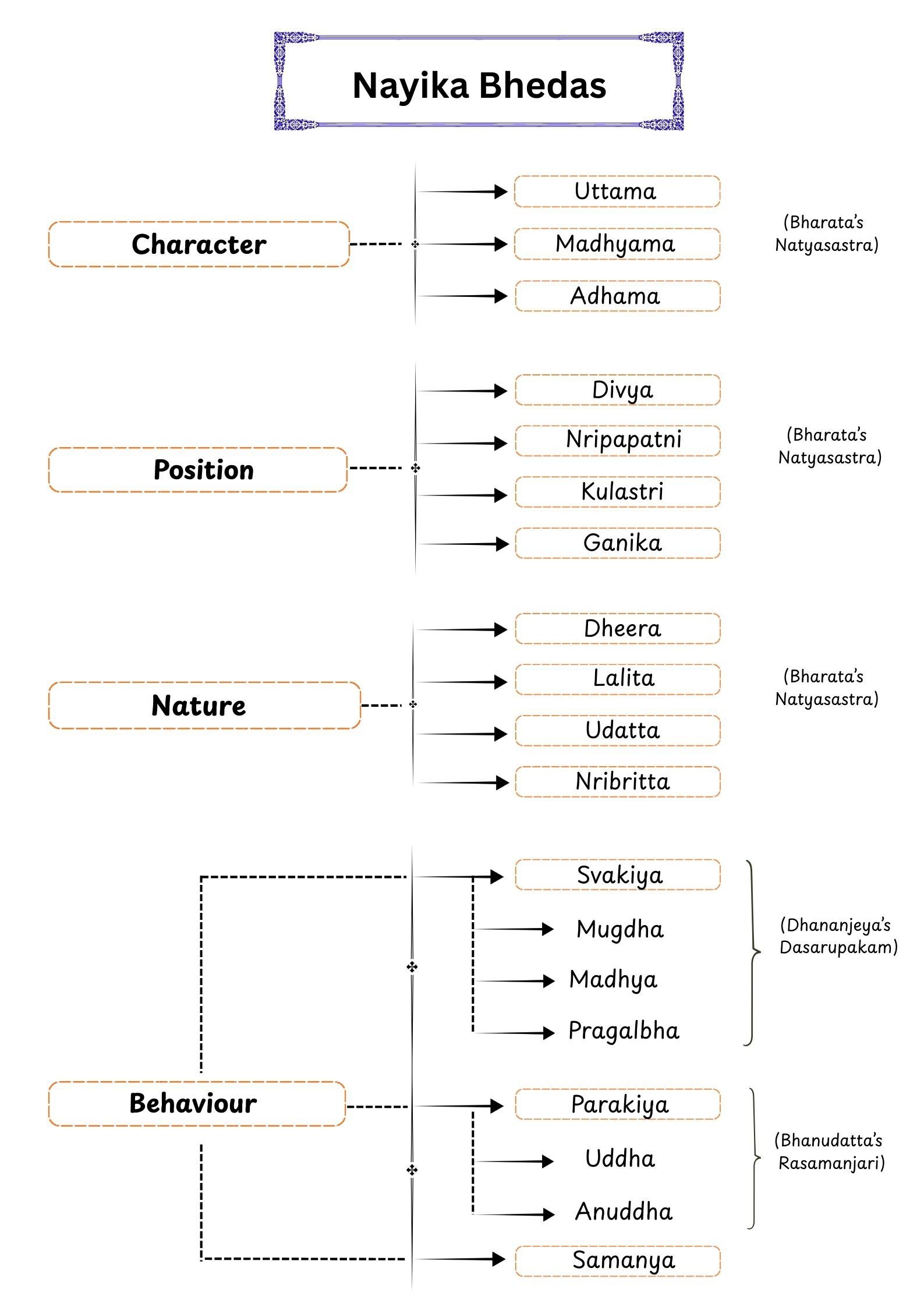
I have collated the following tables that illustrate the different classifications for a Nayaka and Nayika as given in various texts based on their character, behaviour, position, nature and attitude as a learning resource.
Character
- Uttama - complete control of his emotions, scholarly, well-versed in arts and warfare, generous, helping, speaks the truth.
- Madhyama - an expert in arts, trustworthy, loving, helpful but he is not as exalted as Uttama character.
- Adhama - deceit, untrustworthy, kills people, tells lies, always angry, haughty.
Behaviour
- Dheerodhatta - controls himself but there is a sense of pride (celestial Gods)
- Dhiralalitha - self controlled, graceful, charming (King)
- Dhirodaata - self controlled with humility (ministers/warriors)
- Dhiraprashantha - self controlled and peace loving attitude (learned men/merchants)
| Relation to women | Attitude towards women |
|---|---|
| Pati - married and faithful to his wife | Anukoola - who is faithful to woman |
| Upapati - is married and in love with another women | Dakshina - loves all women equally including his wife or wives |
| Vaisika - one who pays and enjoys with other women | Drishta - does not care for abuse, even beating, does not admit his fault |
| Satha - the deceitful one |
Character
- Uttama - who speaks softly, is full of humility, graceful, control of senses, pays respect to elders, very attractive, respectable and trustworthy.
- Madhyama - talented, has many good qualities, well behaved but not as exalted as uttama.
- Adhama - all the bad qualities of adhama purush are applicable to women too.
| Position | Nature |
|---|---|
| Divya - Divine/ Goddess | Dheera - quiet |
| Nripapatni - Queen | Lalita - graceful |
| Kulastri - wife /a member of royal family | Udaatta - restraint |
| Ganika - Prostitute | Nribritta - fearless /does not have exalted qualities |
Behaviour: Nayika in relation to her Nayaka
Svakiya: Married and faithful to her husband. She is of good character and spends her time serving her hero passing through every circumstance sincerely. It can be further classified as: Mugdha - inexperienced in love ; Madhya - partly experienced ; Pragalbha - mature in the art of love
Parakiya: She belongs to one person but has feelings for another man. Rasamanjari further classifies into 2 types - Uddha (married woman) Anuddha (unmarried woman).
Samanya: She is a courtesan, who is free and attaches herself to anybody for self betterment as well as for price with her charm.